Billecart-Salmon: La révolution de Le Réserve
When I visited Billecart-Salmon in the depth of winter 2025, I knew something big was brewing, but I could never have anticipated just how big. My suspicions were confirmed the moment we sat down around the oval table in the eloquent new tasting room of the house. Over sixteen years and some fifty visits at this beloved house, never has the CEO himself sat in to introduce not just a new cuvée but a reinvention of the fundamentals of champagne.
That cuvée was Le Réserve, the shiny new reincarnation of Brut Réserve NV. This is no surface refresh by the marketing department. In fact, the new name was the least significant news of the day. It’s no longer labelled ‘Brut’ because the dosage has been lowered so much that it is now ‘Extra Brut’. Which, as it turns out, was the second least important news.
What seventh generation CEO Mathieu Roland-Billecart unveiled that winter’s morning was not just a refinement of his family house style but a profound declaration of the future of champagne in the wake of the ongoing evolution of the climate, both of the weather and of the market. The result is the first manifestation of Billecart’s complete and courageous reinvention of the fundamentals of champagne from the ground up, a grand testimony to the new and ever more fanatical approach of this lauded house in the vines, the cuverie and the cellar – all the more profound, poignant and daring to launch with the drought and heatwave year of 2020.
‘“Brut Reserve” is now “Le Réserve,” to reflect the evolution in the grapes, the reserves, the use of oak and the dosage,’ introduced Cellar Master Florent Nys. ‘We have done a huge amount of work since Mathieu and I commenced in 2018.’
‘When I took over since harvest 2018 our champagne range was very traditional, like a triangle, with the best wines at the top, but our top four prestige cuvées only represent 2-3% of our production,’ pointed out Mathieu Roland-Billecart. ‘And I did not like the idea that “this is just my brut,” so we wanted to rethink how we define the range with a new philosophy of four savoire-faires: assemblage with Le Réserve and Cuvée Nicolas François, rosé with Le Rosé and Cuvée Elisabeth Salmon, blanc de blancs with Le Blanc de Blancs and Cuvée Louis and oak barrel vinification with Le Sous Bois and Le Clos Saint-Hilaire.’
Mathieu, Florent and their team set out to achieve this in five ways: more honed selection of meunier, creation of a second wine, increased ageing on lees, greater proportion and depth of older reserve wines, more vinification in oak barrels and lower dosage.
In harvest 2019 a new second wine was created, named ‘Inspiration 1818 Brut NV’. This represents roughly the bottom 10 percent of Brut Réserve, which allows the house to ‘massively’ increase the quality of Brut Réserve. ‘We continue to onsell the second press and faulty wines,’ Mathieu explained, ‘but we also have faultless wines that are not of the character that we would like. And so we no longer treat Le Réserve as our entry wine.’
Sourcing of meunier in the Vallée de la Marne was completely overhauled. ‘We cut 50 hectares of growers over three years in terroirs that we didn’t feel were as well aligned with our vinification and where we wanted to take Le Réserve,’ Mathieu revealed. ‘This was a painful process, and we were respectful of our growers and helped them find new homes. We are now more focused on Damery and Venteuil for more solid pinot-noir-like meunier, and Leuvrigny and Fesigny for lighter meunier. Now 80 percent of our meunier is sourced from these four villages.’
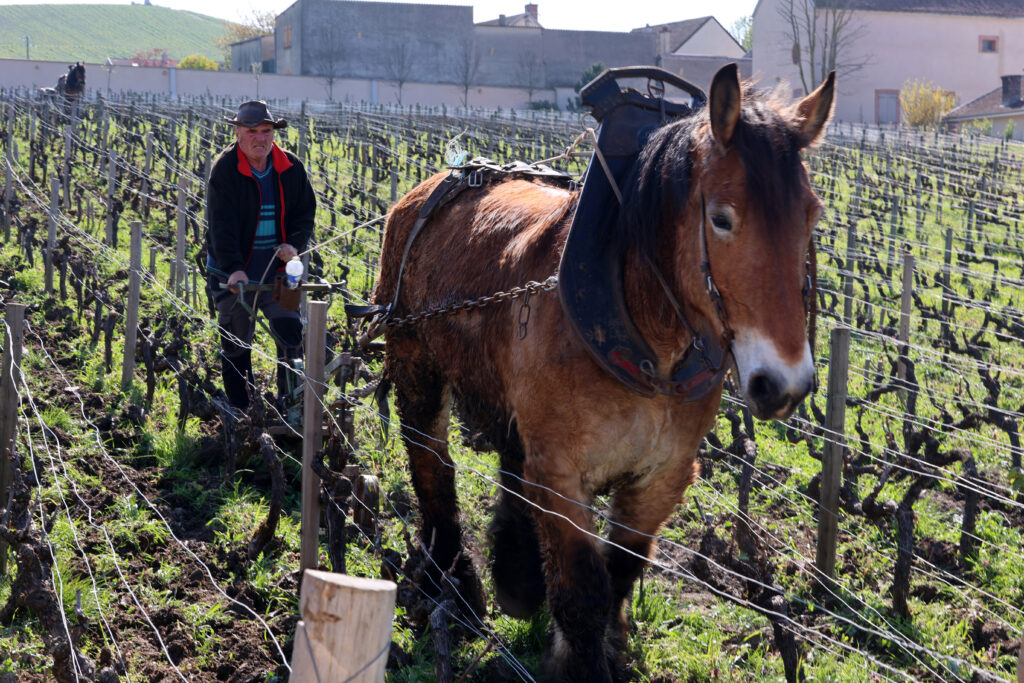
The house is now organic in its own 100 hectares of vineyards, and increasingly biodynamic.
‘With these raw materials revitalised, we are increasing the aging on lees,’ Mathieu explained. When he arrived in 2018, Brut Reserve matured for 30 months on lees and now Le Réserve enjoys between 48 and 55 months, with an average of 50. To achieve this, an additional 1.5 million bottles were added to the cellar, and a new cellar created in the nearby village of Oiry to accommodate this burgeoning stock.
In addition, the percentage of wines vinified in barrels was increased from three to five percent in the past to now eight to ten percent, facilitated by the acquisition of more large foudres.
The proportion of reserves in the 2020 base blend was also increased to an incredible 71% (it was 55-64% in the past), of which half (35% – a huge increase from 9-13% previously) was a perpetual reserve blend from 2006 to 2019, making Le Réserve a blend of 15 different vintages (it was 11 before). ‘And so, Le Réserve today has had almost 20 years of work!’ Mathieu exclaimed.
‘Since 2018, we have moved away from the concept of “house liquor,” as this does not align with our concept of farming or of precision winemaking. Florent has done a significant amount of work with the tasting committee with 50 tanks for liquor, with miniblends to create specific liqueurs for each blend.’
As a result, dosages of 7-9g/L in the past are now 1-5g/L. ‘We did not enter this process with the intention of lowering the dosage, but with longer time on lees, more oak and older age of reserves, we feel our wines achieve a balance at lower sugar levels,’ Mathieu clarifies. ‘Is this due to greater maturity in the grapes? No, because we did the same with Cuvée Nicolas François 2008, not a particularly ripe year at all! We have sent many wines for analysis and many Brut Nature wines in Champagne have more sugar than our Le Réserve! And so we have taken Brut off every label.’
‘Some big changes and some small refinements, to produce more pure and more precise wines,’ Mathieu summed up. ‘Champagne has grown in diversity, but there is too much label selling and not enough winemaking – and we know which camp we want to be in! We stand for making exceptional wines.’
This represents a vital chapter in the ever-evolving story of champagne’s continual reinvention, imagined and brought to life by its keenest and most progressive and fanatical minds. Jacquesson set the scene with its 700 series and Louis Roderer with Collection. Now Billecart’s reinvention is every bit as groundbreaking and fundamental.
You’re invited to join me and Antoine Roland-Billecart in Sydney on 14 May to experience Billecart’s four new revolutionary non-vintage cuvées, alongside five exemplars of its prestige collection! Full details.
Full reviews of Le Réserve, Le Rosé, Le Blanc de Blancs and Le Sous Bois will be published at Champagne.Guide.

By Tyson Stelzer
18 Apr 2026
Tyson Stelzer is a multi-award winning wine writer, television host and producer and international speaker. He was named The International Wine & Spirit Communicator of the Year, The Australian Wine Communicator of the Year and The International Champagne Writer of the Year. He is the author and publisher of seventeen wine books, contributor to many wine magazines, a frequent judge and chair at Australian wine shows and a presenter at wine events in 12 countries. TysonStelzer.com is your link to wine recommendations, book sales, tours and events.

We'd love to add you to our list of friends so you’re first to receive updates on all our upcoming dinners, tastings, tours, articles and books.